Uber Keeps Refusing Guide Dogs at Australian Airports. Here’s Who Actually Shows Up.



Save $50 on Your First Ride with Cars On Demand.

This week, Guide Dogs NSW/ACT celebrated International Guide Dog Day 2026 at Martin Place in Sydney, under the theme “Not all heroes wear capes, some wear harnesses.” Thousands of Australians gathered to recognise the life-changing bond between guide dog handlers and their animals.
On the same day those celebrations were happening, Australians with guide dogs were still being refused rides at airport kerbsides.
It should not take 32 attempts to get a ride home from a doctor’s appointment.
It should not take three Uber drivers at an airport rank before someone agrees to let a blind passenger and his trained Seeing Eye Dog into the car.
And yet, in Australia in 2024 and 2025, both of those things happened. They are documented. They are now the subject of legal action. And they are, according to advocacy groups, far from isolated.
This is a story about a failure by one of the world’s largest rideshare companies to protect some of its most vulnerable passengers. It is also a story about what reliable transportation actually looks like, and why the professional chauffeur industry, not the gig economy, has consistently been the answer for Australians who cannot afford to be left stranded.
What Has Actually Happened to Guide Dog Handlers Seeking Airport Transfers in Australia
Melbourne Airport, February 2023
Social justice law firm Maurice Blackburn filed a discrimination claim against Uber and Melbourne Airport after a passenger and his Seeing Eye Dog were refused two Uber rides at Melbourne Airport’s Terminal 2 rank. The passenger, Melbourne resident Peter Frank, is legally blind and relies on his Seeing Eye Dog Anya for travel.
The first driver refused to take Mr Frank and Anya, telling him he should have ordered an Uber Pet service at additional cost. An airport Uber attendant directed Mr Frank to a second car, but the second driver also refused and drove off. Another waiting passenger boarded an Uber while Mr Frank stood at the rank. He was eventually accepted by a third driver.
Mr Frank described the experience as “upsetting and humiliating.” He said: “These incidents have left a lasting impact on me. I am reticent to take Anya out on occasions out of concern that we will be rejected by drivers.”
The claim was filed with the Victorian Civil and Administrative Tribunal (VCAT) and seeks an order that Uber and Melbourne Airport stop discriminating against passengers travelling with Seeing Eye Dogs, along with a public apology and compensation.
Victoria, 2021 to 2022: 32 Refusals. One Passenger. A Federal Court Case. And Now a 2026 Settlement.
Paula Hobley is blind, lives in regional Victoria, and relies on services like Uber to meet friends, do shopping, go to medical appointments, and get around. Between March 2021 and November 2022, Uber drivers refused to pick her up on 32 individual occasions after she made a booking and let the driver know she was travelling with her Guide Dog, Vonda. Even after reporting each incident to Uber, the refusals continued.
Paula said: “When Uber drivers cancelled on me, I faced long delays trying to secure another ride or was left completely stranded, and missed things like medical appointments and social events.” She added: “I avoid going out at night if I have to rely on a rideshare or taxi service because there’s a risk I won’t be able to get home safely.”
The Justice and Equity Centre represented Paula in a complaint to the Australian Human Rights Commission. When the complaint could not be resolved through conciliation, Paula filed a case in the Federal Court.
In February 2026, that case reached a significant milestone. Uber agreed to a settlement that includes an independent, two-year external review of its Australian operations, chaired by a person with a disability. This is a meaningful outcome, and a direct consequence of Paula Hobley’s determination to pursue accountability through the courts. But a court-ordered review does not undo 32 refusals. And it does not guarantee that the next guide dog handler at an airport kerbside will be treated any differently tomorrow.
The Numbers Behind the Pattern
This is not a story of a few bad drivers. It is a documented systemic problem.
Nearly 50% of Guide Dog handlers told Guide Dogs Australia they had issues with a rideshare or taxi company in the past two years. Over one third said their taxi or rideshare was cancelled, while another 15% were ridiculed or discriminated against in some other way in rideshare situations.
A 2025 academic study published in a peer-reviewed journal found that commercial passenger vehicles, including rideshare services, were the most commonly reported context for access denials among assistance dog handlers in Australia, reportedly occurring about half the time. The study also found that 52% of participants reported intentionally avoiding rideshare or taxi services entirely due to previous experience with access denials.
Read that last figure again. More than half of Australians with assistance dogs have started avoiding transport services altogether because they cannot rely on being accepted. That is not an inconvenience. That is social exclusion.
What the Law Says About Reliable Transportation for Assistance Animal Passengers
Australia’s Disability Discrimination Act is unambiguous. It is unlawful for a business providing a service to discriminate against a person because of their disability, including by refusing access because they use an assistance dog. This applies to rideshare companies operating in Australia.
Individual Uber drivers can be fined for refusing to pick up a person with an assistance animal, but it requires the person with disability to make a formal complaint to a regulator each time. In Victoria, the fine can be as low as $480.
A $480 fine for a multi-billion dollar platform. The incentive structure speaks for itself.
Why Professional Chauffeurs Are the Reliable Transportation Answer for Guide Dog Handlers
The professional chauffeur industry operates under an entirely different model. Where rideshare platforms rely on independent contractors with variable levels of training and inconsistent enforcement of accessibility obligations, accredited chauffeur services operate with employed and vetted drivers, professional codes of conduct, and direct accountability to a brand that has built its reputation over decades.
At Cars on Demand, Australia’s longest-established premium chauffeur network, passengers travelling with guide dogs, Seeing Eye Dogs, and other certified assistance animals are always accommodated. No surcharge. No upgrade required. No driver discretion. Assistance animals are a legal right and our drivers know it.
This is not a policy we wrote in response to a lawsuit. It is how professional ground transportation has always operated.
Guide Dog-Friendly Airport Transfers: What Reliable Transportation Looks Like with Cars on Demand
If you or someone you care for travels with a guide dog or service animal and you have been left stranded, refused, or humiliated at an Australian airport, here is what professional airport transfers actually look like.
Pre-Confirmed Airport Transfers, Not Algorithms
Every Cars on Demand booking is a confirmed reservation. Your driver is assigned in advance through our RideMinder dispatch platform and knows the full details of your trip, including your passenger requirements, before they leave for the pickup. Whether you are booking Brisbane airport transfers after a long-haul flight or Perth airport transfers for an early morning corporate meeting, there is no moment at the kerbside where a driver sees your assistance animal and decides whether to accept the booking.
Reliable Airport Meet and Greet at Every Terminal
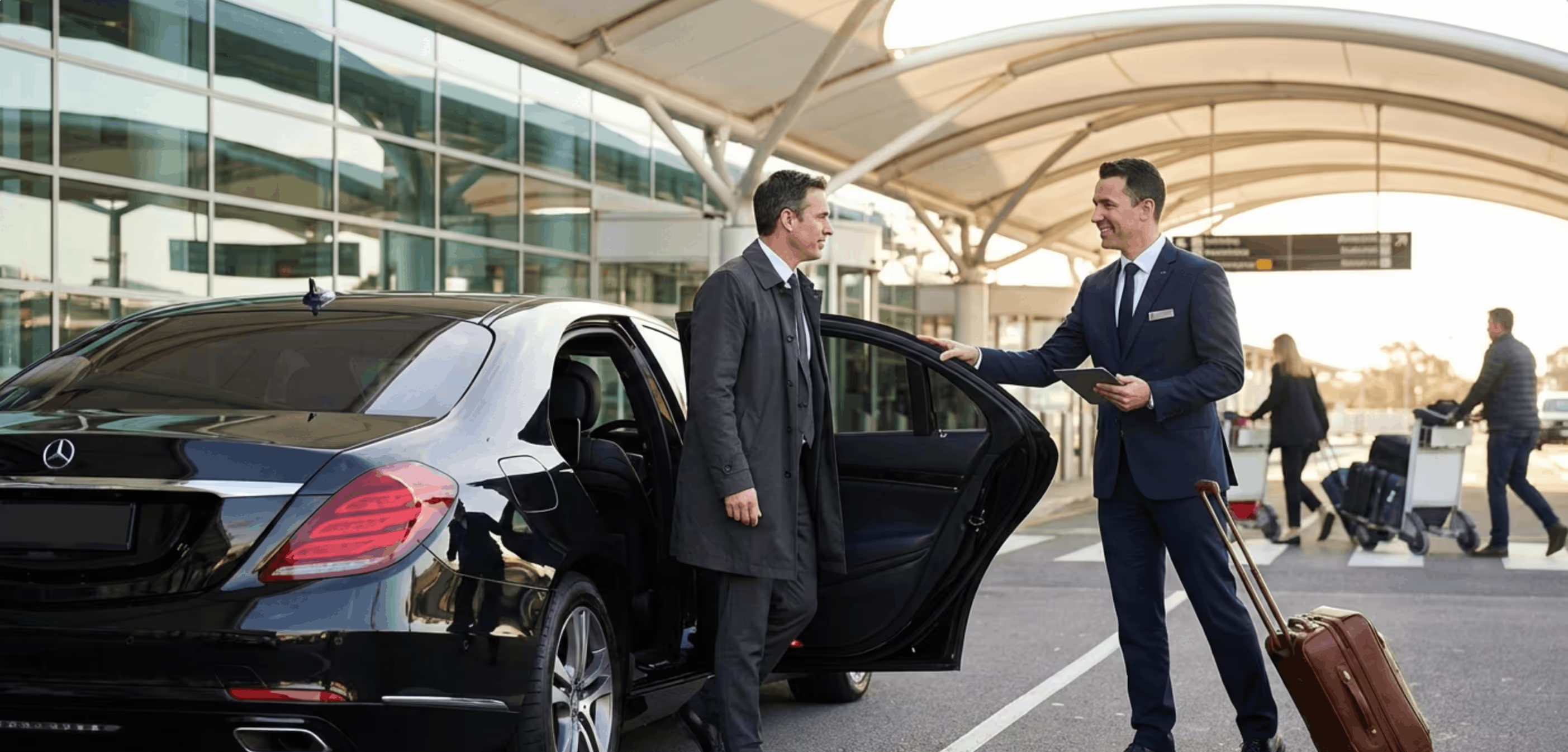
Our meet and greet service means your driver meets you inside the terminal, not at a kerb rank where you are competing with other passengers for a car that might not accept you. Whether you need Sydney airport transfers to the CBD or Melbourne airport transfers for a medical appointment, our drivers are positioned at specific meeting points inside the terminal before you arrive. For passengers travelling with assistance animals, this is the difference between a seamless arrival and the experience Peter Frank described at Melbourne Airport.
Fixed Pricing for Airport Transfers — No Surge, No Add-On Fees
There is no “assistance animal surcharge.” There is no equivalent of being told to book the more expensive option because your dog is not a pet. Our pricing is fixed and transparent before you book, whether that is Adelaide airport transfers, Gold Coast airport transfers, or anywhere else across our national network.
Reliable Transportation Across Every Major Australian City
Cars on Demand operates airport transfers in Sydney, Melbourne, Brisbane, Perth, Adelaide, Gold Coast, Canberra, Darwin, Sunshine Coast, and Cairns.
Whether you are travelling from Sydney’s T1 International, T2 (Virgin Australia Domestic), or T3 (Qantas Domestic), or arriving into any other major Australian airport, a Cars on Demand driver will be there. With your dog. Without incident.
A Note to Executive Assistants Booking Airport Transfers for Others
If you are an EA managing travel for executives, directors, or clients who travel with assistance animals, the pattern described in this article should be enough to move your airport transfer bookings permanently away from rideshare platforms. That applies whether you are coordinating Canberra airport transfers for a government delegation or Darwin airport transfers for a remote site visit.
The reputational and logistical risk of a principal being refused at an airport kerb, left standing in front of other passengers while drivers reject them, is not acceptable. The Cars on Demand executive assistant portal allows you to manage recurring bookings, pre-set passenger requirements, and track every trip in real time. Over 5,000 executive assistants across Australia already use it.
The Broader Question: What Does Reliable Transportation Actually Mean?
Reliable transportation is not measured by how quickly an app finds a car on a good day. It is measured by what happens when something goes differently, when the passenger has a guide dog, when the flight is delayed, when the driver is not who you expected, when the system lets someone down.
Paula Hobley described what unreliable transportation means in practice: “After 32 stressful and anxiety-provoking cancellations, I now carefully weigh the risk of a cancellation and the personal cost of that against the benefit of doing an activity. Sometimes I don’t engage in activities if the personal cost is too high.”
That is the true cost of unreliable transportation for people with disabilities. Not inconvenience. A smaller life.
On International Guide Dog Day, Guide Dogs NSW/ACT celebrated its clients and their animals under the theme “Not all heroes wear capes, some wear harnesses.” Guide dogs make independence possible. Reliable airport transfers make that independence real, from the moment a plane lands to the moment the front door opens at home.
Cars on Demand has operated for 35 years and holds a 99.99% on-time reliability record across approximately 1,500 drivers and eight Australian cities. That record was built on the understanding that showing up, for every passenger, every time, is not a feature. It is the baseline.
Book a Guide Dog-Friendly Airport Transfer That Will Always Show Up
If you travel with a guide dog or assistance animal and you are tired of uncertainty, you deserve a better option.
View our full fleet and book your next airport transfer with a chauffeur service that has never needed a court to tell it to do the right thing.
New to Cars on Demand? Our $50 off your first airport transfer offer is available now.
Frequently Asked Questions
Can I travel with a guide dog or assistance animal in a Cars on Demand vehicle? Yes, always and at no extra charge. Certified assistance animals are accommodated on every booking across all Australian cities we operate in. This is a legal right under Australia’s Disability Discrimination Act and our drivers are trained accordingly.
What airports does Cars on Demand service? We provide airport transfers at Sydney (T1 International, T2 Virgin Australia Domestic, T3 Qantas Domestic), Melbourne, Brisbane, Perth, Adelaide, Gold Coast, Canberra, Darwin, Sunshine Coast, and Cairns.
Is a rideshare company required to accept my assistance animal? Yes. Under Australia’s Disability Discrimination Act, it is unlawful for a rideshare company to refuse service to a passenger because they are accompanied by a certified assistance animal. The gap between policy and practice is precisely what was tested in the Federal Court, resulting in a February 2026 settlement that includes a two-year independent review of Australian operations, chaired by a person with a disability.
How do I book a Cars on Demand airport transfer? All bookings are made online via the app or at carsondemand.com.au. You can register here. For questions, call 1300 638 258 or internationally on +61 413 905 215, or email admin@carsondemand.com.au. A 24/7 AI assistant is also available through the platform.
What is the difference between a chauffeur airport transfer and a rideshare for passengers with disabilities? A chauffeur airport transfer involves a pre-confirmed booking with a vetted, professionally trained driver who knows your requirements before departure. There is no kerbside lottery. A rideshare involves an algorithm matching you to the nearest available driver, with no pre-screening for accessibility compliance and, as the Federal Court case and its February 2026 settlement demonstrated, inconsistent enforcement of legal obligations to passengers with assistance animals.
Cars on Demand has operated Australia’s premium chauffeur and airport transfer service since 1990. With approximately 1,500 drivers, a 99.99% on-time reliability record, and operations across Sydney, Melbourne, Brisbane, Perth, Adelaide, Canberra, Darwin, Gold Coast, Sunshine Coast, and Cairns, we are Australia’s most experienced ground transportation provider.
All factual claims about legal proceedings in this article are drawn from publicly available statements by Maurice Blackburn Lawyers (November 2024), the Justice and Equity Centre (February 2025), and publicly reported details of the February 2026 Federal Court settlement.
.avif)
Get a quote in 8 seconds