The Airport Transfer Industry Has A Dirty Secret — And Most Travellers Don’t Know It


Save $50 on Your First Ride with Cars On Demand.

TL;DR — The 30-Second Version
- A large portion of “local” Australian airport limo websites are digital storefronts run by offshore tech operators, not real chauffeur companies.
- Your booking is often “blasted” to a pool of independent drivers via WhatsApp or third-party apps — the cheapest or fastest to accept wins the job.
- The same trust collapse currently hitting Booking.com in Australia (ACCC warnings, data breaches, phishing scams) is quietly playing out in the chauffeur industry.
- Real operators own their fleet, employ their drivers, and know the specific chauffeur lanes at each Australian airport. Aggregators do not.
- Cars on Demand is a direct service provider — not an aggregator, not a marketplace, not a white-label booking app.
The Illusion of “Local” Airport Limo Services in Australia
Type “airport limo service Sydney” or “Melbourne chauffeur” into Google right now. You’ll find dozens of slick websites, polished testimonials, and promises of “premium luxury transport” — all claiming to be locally owned, locally operated, and locally accountable.
Most of them aren’t.
The Australian airport transfer industry — covering everything from executive chauffeur services to private car hire and corporate shuttle bookings — has quietly built itself on a foundation that would shock the average corporate traveller. Behind the glossy front-end of many “premium” brands sits a tangled supply chain of outsourced dispatch centres, aggregated driver pools, and shell companies operating in cities they’ve never set foot in.
If you’ve ever stood at an arrivals gate at 11pm wondering why your “guaranteed” pickup hasn’t shown up, you’ve experienced the symptom. The disease is structural — and it’s worth understanding before your next booking.
From the Dispatch Desk: What 30+ Years In This Industry Actually Looks Like
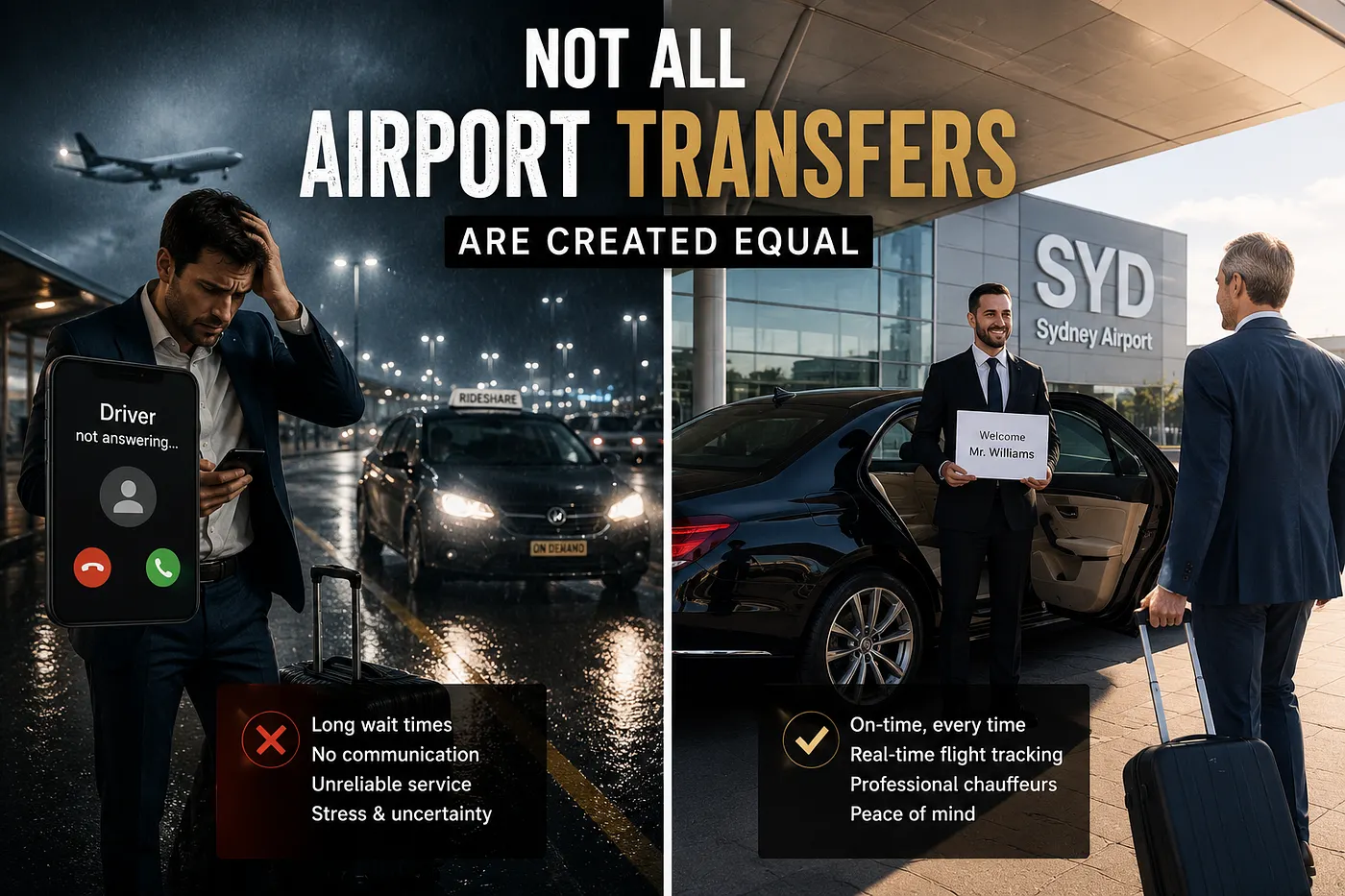
A note from our operations team: In 30+ years running chauffeur operations across Australia, we’ve seen this play out a thousand times. You search for a “Sydney Airport Chauffeur,” click on a local-looking site, and pay a premium. But your money actually lands in a holding account belonging to a tech company in Europe or Asia. They then “blast” your booking out to a WhatsApp group of random drivers across Sydney. The person who picks you up isn’t a trained chauffeur — they’re just the operator who clicked “accept” fastest.
We’ve had clients arrive at our depot in tears at 1am after being abandoned at Sydney Airport by a “premium” service that turned out to be three layers removed from any real operator. We’ve had executive assistants in Melbourne ring us in a panic because the “local company” they booked stopped answering the phone the moment something went wrong. We’ve stood at Brisbane’s chauffeur holding bay and watched drivers turn up in unmarked sedans with no idea which client they were collecting because the booking had been re-sold twice already.
This isn’t a hypothetical. This is what the industry actually looks like behind the websites.
Dirty Secret #1: Your “Local” Operator Is Probably a Call Centre Offshore
Here’s how it works in practice.
A traveller books what appears to be a Brisbane-based airport limo company. The website lists a Brisbane phone number, a Brisbane address, and photos of Brisbane drivers in suits. The booking confirmation comes through instantly. Everything feels legitimate.
What the traveller doesn’t see is that the booking has been routed to a dispatch centre operating from another country — sometimes another continent. The “Brisbane company” is a digital storefront. The dispatcher taking the call has never been to Brisbane Airport, doesn’t know which terminal Qantas domestic uses, and can’t tell you the difference between the Skygate pickup zone at BNE and the public arrivals lane.
When your flight is delayed, that dispatcher doesn’t know. When you walk out and your driver isn’t there, that dispatcher can’t physically check. And when you call to complain, you’re routed back to the same script.
This is the reality behind a significant portion of the Sydney airport transfer industry — and it repeats in Melbourne, Brisbane, Perth, Adelaide, and every regional hub in between.
Dirty Secret #2: “Driver Aggregation” Means Nobody Owns Your Booking
The second layer of the problem is even more invisible to travellers: driver aggregation.
Many companies marketing themselves as “premium chauffeur services” or “executive transport providers” don’t actually employ drivers. They don’t own vehicles. They don’t run training programs. What they have is a website, a booking engine, and an app that pings whichever independent contractor happens to be closest when your booking comes in.
This is fundamentally different from how a proper private car hire and chauffeured fleet operates. Real chauffeur services vet their drivers, maintain their fleet, train staff on airport-specific protocols, and take direct accountability when something goes wrong.
Aggregators do none of this. The driver who picks you up could be:
- A rideshare driver picking up a side gig between Uber jobs
- An owner-operator with no vetting beyond a basic licence check
- Someone who has never driven a corporate client and doesn’t know the protocol
- A driver who was assigned the job 4 minutes before pickup and is running 30 minutes late from across town
When you’re a CEO heading to a board meeting, a finance executive flying in for a closing, or an executive assistant booking on behalf of a senior leader, this matters. The price point looks like “premium.” The actual service is a coin flip.
Dirty Secret #3: Fake Local Companies Are Everywhere
Search “Adelaide airport limo” or “Perth executive transport” and you’ll find websites that look local, sound local, and rank locally. Many of them are not.
A single operator — often based overseas — will run twenty, thirty, sometimes fifty different brand websites, each targeting a different Australian city. Each site claims to be the “trusted local choice.” Each one routes bookings back to the same offshore dispatch hub. Each one then sub-contracts the actual driving to whoever is available.
This isn’t theoretical. It’s how a substantial share of the Australian online airport transfer market actually functions in 2026.
Why the “Booking.com Scam” Pattern Is Coming for the Chauffeur Industry
Australian consumers have been getting a crash course in aggregator risk over the past 12 months — and it has nothing to do with chauffeurs.
Booking.com is currently facing intense Australian scrutiny, with hundreds of complaints filed with fair trading bodies, an ACCC warning over surging phishing scams that have already cost Australians hundreds of thousands of dollars, and a serious 2026 data security incident where customer names, addresses, and phone numbers were accessed by unauthorised parties. The platform was ranked among the most-complained-about companies in NSW.
The thread running through every Booking.com story is the same: when you book through an aggregator, nobody in your country actually owns the experience. The hotel didn’t take the booking. The platform passed it through. When something goes wrong, the buck has nowhere to land.
The airport transfer industry is structurally identical — and Australian travellers are about to learn the same lesson the hard way. The “local chauffeur company” you booked may have no more accountability than a third-party hotel listing. When your driver doesn’t show, there’s no Australian operator on the other end of the phone who can physically fix it.
The difference is timing. The Booking.com story is on the front page of the ABC. The chauffeur version is quietly happening at arrivals halls every night, one stranded traveller at a time.
Dirty Secret #4: Unreliable Airport Pickups Are a Feature, Not a Bug
Here’s the part that frustrates corporate travel managers the most: when your airport pickup fails, it’s rarely a one-off mistake. It’s the predictable output of a broken system.
Consider what a proper airport pickup actually requires:
- Live flight tracking that adjusts pickup times for delays and early arrivals
- Granular knowledge of airport meeting points — every Australian airport has its own pickup zones, chauffeur lanes, holding areas, and curbside rules
- Local driver bandwidth — actual drivers actually nearby, not 45 minutes away
- Direct accountability — one company that takes responsibility from booking to drop-off
- Real-time communication — a dispatcher who can speak to both the driver and the client when something changes
Aggregator models can’t reliably deliver any of this. Their drivers are independent contractors juggling multiple platforms. Their dispatchers are remote. Their “tracking” is a status field in a database, not a person watching your flight land.
Local Knowledge: The Specific Details Only Real Operators Know
This is where ghost companies fall apart fastest. Here’s what an actual on-the-ground operator knows about Australia’s busiest airports — and what an offshore dispatcher doesn’t:
- At Sydney (SYD) T1 International, the dedicated chauffeur lane and the short-stay car park have completely different walking distances and pickup windows. A real chauffeur is already parked 15 minutes before your flight lands, not circling Mascot.
- At Sydney T2/T3 Domestic, the priority chauffeur pickup area is different again, and the holding bay rotations during peak hour require local timing knowledge.
- At Melbourne (MEL) T1, the short-term meet-and-greet point is distinct from the rideshare zone — confusing these will cost you 20 minutes.
- At Brisbane (BNE), the Skygate holding area and the new airport pickup arrangements have changed multiple times in recent years.
- At Perth (PER) T1, the international chauffeur protocol is materially different from T3/T4 domestic.
- At Adelaide, Canberra, Gold Coast, Sunshine Coast, Cairns, and Darwin, every airport has its own meet-and-greet quirks that take years of operational presence to learn properly.
An aggregator dispatcher 8,000km away cannot know any of this. A real operator builds standard procedures around it — Cars on Demand even publishes them for major venue pickups like Accor Stadium so corporate travellers know exactly what to expect.
Service Area: Where Cars on Demand Actually Operates
Cars on Demand maintains a physical operational presence — vehicles, drivers, and local dispatch — across:
- Sydney: CBD, North Shore, Eastern Suburbs, Inner West, Northern Beaches, Sutherland Shire, Western Sydney, Parramatta, Macquarie Park, Sydney Olympic Park
- Melbourne: CBD, Southbank, Docklands, South Yarra, St Kilda, Brighton, Toorak, Hawthorn, eastern and bayside suburbs
- Brisbane: CBD, Fortitude Valley, New Farm, South Brisbane, Newstead, Hamilton, plus broader SEQ runs
- Gold Coast and Sunshine Coast: resort, conference, and intercity transfers
- Perth: CBD, West Perth, Subiaco, Cottesloe, plus FIFO and corporate transfers
- Adelaide, Canberra, Cairns, Darwin: full city coverage and airport servicing
If we operate in a city, we have drivers, dispatchers, and accountability on the ground. If we don’t, we say so.
How to Tell If You’re Booking a Real Chauffeur Service Or a Ghost Brand
If you’re an executive assistant, procurement manager, or frequent business traveller booking Sydney airport limo services and equivalent across Australia, here’s a quick due-diligence checklist:
A useful test: ask the company which terminal their drivers use for Qantas domestic pickup at Sydney, or where the dedicated chauffeur holding area is at Melbourne T1. If the answer is vague, you’re almost certainly speaking to a dispatcher who has never been to either airport.
Why Cars on Demand Operates Differently
Cars on Demand was built specifically to solve the structural problems above — not just to compete on price.
We operate a real fleet with directly employed, vetted chauffeurs across every major Australian city. We use purpose-built dispatch technology powered by Rideminder that tracks every flight in real time, adjusts pickup windows automatically, and keeps both the driver and the dispatcher accountable to a single live record.
Our airport pickup protocols are documented down to the specific meeting points at each terminal. Our drivers are already there before your flight lands. And when something does go wrong — because in this industry, occasionally it will — there is an Australian operator on the other end of the phone who can physically fix it.
This is why CEOs, executive assistants, and corporate procurement teams choose Cars on Demand for their premium airport limo service — not because we’re the cheapest, but because we’re the operator that actually exists when things matter.
Frequently Asked Questions
Is Cars on Demand a booking aggregator? No. Cars on Demand is a direct service provider. We own and operate our own dispatch, employ our own chauffeurs, and run our own fleet across Australia. We do not “blast out” jobs to third-party drivers, and we do not white-label other operators’ services.
How do I know if a chauffeur service is a fake local company? Look for these signals: an Australian phone number that connects to Australian staff during business hours, specific knowledge of local airport pickup zones, transparent ownership of the fleet, and direct accountability for service failures. Vague answers about driver employment, generic stock photos, and an inability to describe specific terminal procedures are red flags.
How can I tell if an airport limo service in Australia is genuinely local? Call the number on the website and ask specific operational questions — which terminal they use for a particular airline, where their drivers wait, who runs their fleet. A real local operator answers immediately. An aggregator hedges or transfers you.
What’s the difference between a chauffeur service and a rideshare or taxi? A genuine chauffeur service employs and trains its drivers, maintains its own executive fleet, and takes full accountability for the journey. Rideshare and taxi services are aggregators by design — your driver is whoever happens to accept the job, with no consistent service standard or corporate-grade protocol.
Why do my airport pickups keep getting cancelled or running late? This is the most common symptom of booking through an aggregator. The booking is real; the driver allocation isn’t. Booking with an operator that owns its fleet and dispatch dramatically reduces this risk.
How much does a premium airport transfer cost in Australia? Pricing varies by city, distance, and vehicle class, but a transparent operator will give you a fixed quote upfront with no surge pricing or hidden fees. Unusually cheap “premium” quotes usually indicate aggregated supply.
Can executive assistants set up corporate accounts for regular bookings? Yes. Cars on Demand offers corporate accounts, consolidated invoicing, and a dedicated workflow specifically for executive assistants managing senior leadership travel.
The Bottom Line
The airport transfer industry’s dirty secret isn’t that bad operators exist — every industry has those. The secret is how systematically the bad operators have learned to look like the good ones, and how little protection corporate travellers have when the booking inevitably fails.
The same trust collapse currently swallowing Booking.com in Australia is coming for the chauffeur industry. The fix isn’t more vigilance from travellers — it’s choosing operators that are structurally incapable of pulling these tricks. Operators with real fleets, real drivers, real dispatch, and real accountability on the ground in Australia.
If your organisation books executive transport across Australian capitals and regional hubs, it’s worth taking a hard look at who actually fulfils those jobs once the booking goes through. The brand on the invoice and the company behind the wheel are not always the same thing.
Ready to book a chauffeur service you can actually rely on? Register or download the Cars on Demand app here — or claim our $50 off your first premium airport transfer. Direct service. No aggregators. Real drivers. Across every major Australian city.
.avif)
Get a quote in 8 seconds