How to Arrange Conference Transfers in Australia: A Practical Guide for Event Managers


Save $50 on Your First Ride with Cars On Demand.

By Cars on Demand | Published 17/06/2026| 8 min read
Conference transport is the part of event planning nobody thinks about until something goes wrong. A keynote speaker stuck in a rideshare queue 20 minutes before they are due on stage. Two hundred delegates competing for taxis when a session wraps at 5pm. An interstate VIP who has just flown four hours standing at arrivals wondering where their driver is.
None of these are hypothetical. They happen at Australian conferences every year, because transport was treated as a logistics footnote rather than an operational pillar.
This guide walks through how to arrange conference transfers properly — from the first planning conversation through to the final delegate departure — so that transport is the one thing your attendees never have to think about.
Why Conference Transport Is More Complex Than It Looks
The common mistake is treating conference transport as a series of individual bookings. Book a car for the keynote speaker. Arrange a few airport pickups. Sort out the rest on the day.
The problem is that conference transportation is not a collection of one-off trips. It is a system, and every part of that system depends on the parts around it.
Airport pickups feed into hotel arrivals. Hotel arrivals feed into morning shuttle loops. Shuttle loops feed into session start times. Off-site dinner transfers feed into return runs that need to be staged before the restaurant empties. Delegate departures on the final day need to be pre-staged before the closing session ends — not called for when people are already at the door with luggage.
When one link in that chain breaks, every delegate downstream feels it. A 15-minute delay on a morning shuttle can push back an entire day’s programme. A single missed airport pickup for a VIP speaker creates a reputational problem that no amount of good content from the stage will fix.
Australia adds its own complexity. Delegates at a Sydney conference may be flying in from Perth, Brisbane, Melbourne, Adelaide, and Cairns — on different airlines, arriving across different terminals, at different times. A delegate flying Perth to Sydney has covered 2,700 km before they set foot in the arrivals hall. That airport transfer is their first impression of your event. A professional meet-and-greet with a suited chauffeur holding their name sets the right tone immediately. A 40-minute wait on a rideshare app that keeps moving its ETA does the opposite.
Step 1: Start Planning Earlier Than You Think You Need To
For large conferences — 200 or more delegates — transport planning should begin six to eight weeks before the event. For smaller corporate events, two to four weeks is workable, but earlier is always better.
Why the lead time? A few reasons that are easy to underestimate:
Vehicle availability. During Australia’s peak conference season — March to May and August to November — demand for executive sedans, people movers, and minibuses concentrates around the same major convention centres. Leave it too late and the vehicle mix you need simply is not available.
Driver briefing. A professional conference transport provider does not just assign a driver and send them an address. Drivers need to be briefed on the specific venue loading zones, hotel entrances, event day protocols, and passenger lists before the programme begins. That preparation takes time.
Loading zone approvals. For major CBD venues like ICC Sydney or MCEC Melbourne, there are specific drop-off zones, timing restrictions, and access protocols that need to be confirmed with the venue in advance. This is not something to sort out on the morning of day one.
Transfer manifest build. The master document that maps every delegate movement — pickup times, names, flight numbers, vehicle assignments, drop locations — takes time to build properly from the conference agenda. Rushed manifests have gaps. Gaps become problems on the day.
Step 2: Build Your Transfer Schedule from the Programme
The conference agenda is your transport blueprint. Every session start time, every break, every off-site function, and every departure window creates a transport demand point. The transfer schedule should be built directly from the agenda — not worked backwards from what vehicles happen to be available.
Go through the programme and mark every moment where delegates need to move:
- Arrivals: Which delegates are flying in? From where? What time do their flights land? Which airport terminal?
- Morning sessions: What time do sessions start? When do delegates need to leave their hotels to arrive on time?
- Off-site functions: Is there a gala dinner, site visit, or awards night? How many delegates are going? What time does it start and finish?
- Social events: Post-session drinks, partner programmes, networking dinners — each one needs its own transfer plan.
- Departures: What flights are delegates catching on the final day? What time do they need to leave the venue?
Every one of these becomes a line in your transfer manifest. Once the manifest is built, you have a clear picture of the vehicle numbers, timing, and sequencing you need. Before it is built, you are guessing.
Step 3: Match Your Vehicle to the Delegate
Not every delegate needs the same vehicle. A tiered approach keeps the programme cost-proportional and operationally clean.
The key distinction is between as-directed (hourly) hire and point-to-point fixed transfers.
As-directed hire means the vehicle and chauffeur are allocated to one person or group for a set period and go where needed, wait as long as required, and adapt to schedule changes without a rebooking. This is the right model for VIPs and speakers, where the session might run long, the pre-event dinner might extend, or a last-minute schedule change means the pickup needs to shift by an hour.
Point-to-point fixed transfers are scheduled pickups with a defined route and timing. The right model for general delegates whose movements are predictable and tied to the programme schedule.
For groups with luggage — particularly delegates arriving or departing via airport — also factor in baggage capacity. A people mover that seats six may only practically carry four people if everyone has a conference bag and a checked suitcase.
Step 4: Treat Airport Transfers as the Highest-Priority Element
Of all the transfer types in a conference programme, the delegate airport transfer is the one with the least room for error and the most variables working against you.
Flights get delayed. They arrive early. They land at a different terminal than originally scheduled. A delegate who has been travelling for five hours has no patience for confusion at arrivals.
The things that need to be in place for professional conference delegate airport transfers:
Real-time flight monitoring. Your transport provider should be tracking every incoming flight, not relying on the scheduled arrival time. If a flight is delayed by 45 minutes, the driver adjusts their positioning — they are not waiting at arrivals for 45 minutes burning time, and they are not leaving before the delegate lands.
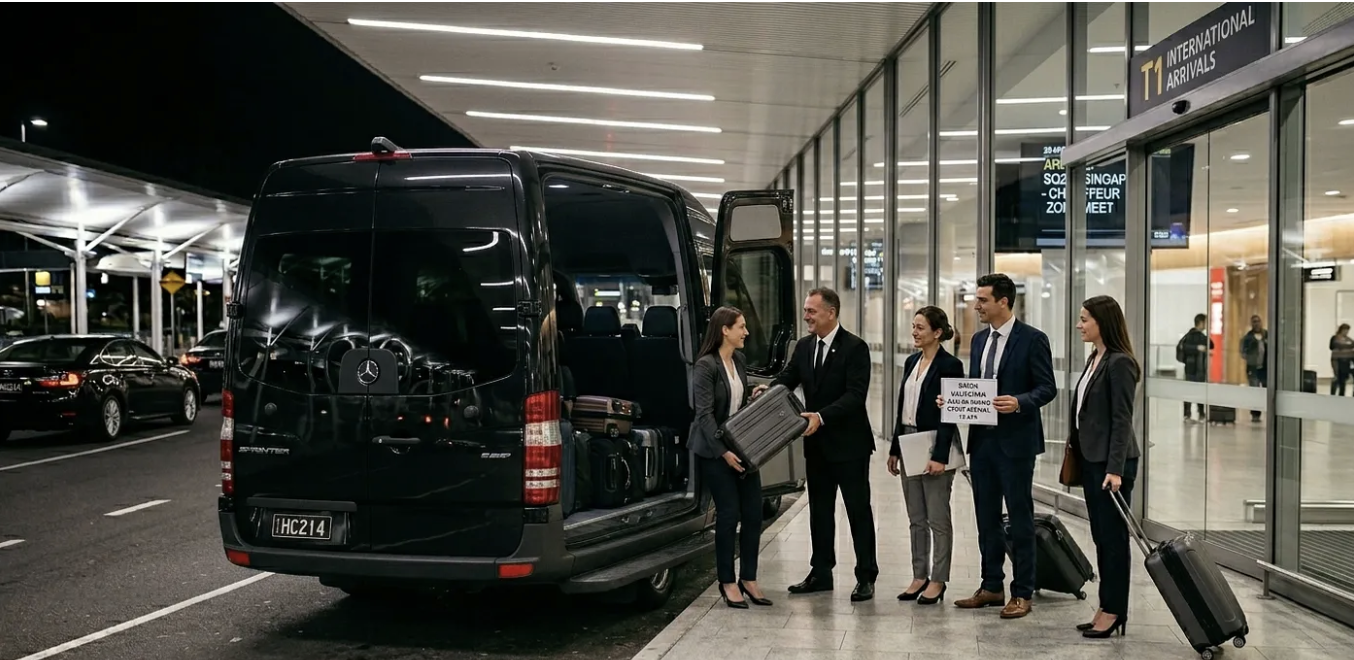
Meet-and-greet as standard for VIPs. For keynote speakers, sponsors, and senior executives, a chauffeur waiting in the terminal with name signage is non-negotiable. The delegate walks out of customs, sees their name, and goes directly to the vehicle. No navigation, no uncertainty, no calling a number and trying to describe where they are standing.
Pre-communication to delegates. Every arriving delegate should receive their driver’s name, mobile number, and a live GPS tracking link before they board their flight. They know exactly who is picking them up, where to walk, and who to call if something is unclear. The whole exchange at arrivals takes 90 seconds.
A single point of contact for changes. Flights change. Delegates miss connections. A VIP gets upgraded to an earlier service. Your transport provider needs to be reachable 24/7 and able to adjust a transfer without requiring you to cancel and rebook through an online platform.
Step 5: Plan for the End-of-Day Rush
The moment when a conference session ends and hundreds of delegates simultaneously need transport is the hardest moment to manage in any event transport programme. Practitioners call this the 5pm rush problem, and it takes every conference by surprise if it has not been specifically planned for.
When 300 delegates walk out of a closing session at the same time, rideshare apps detect the demand surge and pricing spikes. Drivers avoid the congested area. Wait times blow out. Delegates who were patient all day become frustrated in the final 30 minutes of your event.
The solution is pre-staging. Vehicles need to be positioned at the venue before the session ends, not called for when delegates are already at the door. Departures should be staggered where the programme allows — groups of delegates departing at intervals rather than all at once. Drivers should be given a clear briefing on staging locations and departure sequences in advance.
This applies to the post-event airport rush on the final day as well. If 60% of your delegates are catching flights in a two-hour window on the afternoon of day three, those vehicles need to be confirmed, staged, and sequenced the day before — not organised on the morning.
Step 6: Choose a Provider That Can Cover the Full Programme
For anything beyond a small single-day event, the transport provider you choose will make or break the programme. A few things worth evaluating:
National coverage. Australian conferences regularly draw delegates from multiple states. A provider that operates in Sydney but not Melbourne, or that has strong CBD coverage but no airport capability, forces you to manage multiple relationships and multiple invoices. One provider, one account, one contact across the entire country simplifies everything.
Fleet range. Can they cover an executive sedan for the keynote speaker, a people mover for a small delegate group, and a minibus for the hotel shuttle loop — under the same booking? If not, you are coordinating multiple operators.
Fixed pricing. Conference transport happens during exactly the moments when rideshare surge pricing is at its worst. A provider offering confirmed fixed-price transfers removes the budget uncertainty entirely. The price on the quote is the price on the invoice.
A conference desk, not just a booking platform. Multi-day conference transport is not something that works well through an online booking widget. You need a human who understands the event, can build the manifest with you, and is reachable when something changes at 7am on day two.
Experience with manifests. Ask directly: do they build and manage transfer manifests for conference programmes? If the answer is vague, they have not done it at scale.
A Note on Australian Conference Venues
Each of Australia’s major convention centres has its own access protocols, loading zone restrictions, and drop-off logistics. These are not things to figure out on the morning of the event.
At ICC Sydney, Darling Harbour, there are specific underground loading access points and drop-off zones that differ from standard street access. The surrounding Darling Harbour precinct also has pedestrian priority areas that affect vehicle positioning during peak event periods. Our Sydney conference shuttle service is fully briefed on these constraints before any programme begins.
At MCEC Melbourne, South Wharf, morning peak traffic on the Citylink and Kings Way approaches requires realistic timing buffers built into the shuttle schedule. Vehicles arriving late into South Wharf during a 8:30am session start will find loading areas congested.
At BCEC Brisbane, South Bank, the proximity to the CBD is closer than it appears on a map when you factor in cross-river traffic and the South Bank pedestrian zone. Hotel-to-venue shuttle timing for morning sessions needs to reflect peak-hour Brisbane conditions, not off-peak travel time.
A transport provider that has worked these venues before will already know this. One that has not will learn it at your delegates’ expense.
The Transfer Manifest: Your Operational Backbone
A transfer manifest is the single document that makes a complex conference transport programme manageable. It lists every delegate movement across the entire event: pickup time, delegate name, flight number (for airport transfers), vehicle assignment, pickup location, and drop location.
Built well, the manifest becomes the reference point for every driver briefing, every schedule change, and every on-the-day decision. When something shifts — a flight delay, a speaker arriving a day early, a VIP needing an unscheduled transfer to a dinner — the manifest is where that change is recorded and communicated.
For a multi-day national conference, a well-built manifest is the difference between a transport programme that runs on autopilot and one that requires constant firefighting.
At Cars on Demand, we build and manage the transfer manifest in collaboration with your event manager or EA. For recurring annual conferences, we retain the programme structure from year to year — so the second year takes a fraction of the setup time the first year required.
Putting It Together
Arranged well, conference transport is invisible to delegates. They arrive at the airport and find a professional waiting for them. They walk out of their hotel at the right time and a vehicle is there. The gala dinner ends and the buses are already staged. The final session closes and departures run like clockwork.
Arranged poorly, transport becomes the thing your attendees remember — for the wrong reasons.
The fundamentals are straightforward: start planning early, build your schedule from the programme, tier your vehicles to match your delegates, treat airport transfers as the highest priority, plan specifically for end-of-day demand, and choose a provider with national coverage and genuine conference experience.
If you are planning a conference and need a transport partner who has managed these programmes across Australia for over 35 years, we would be glad to help.
Contact the Cars on Demand Conference Desk: Email: admin@carsondemand.com.au Phone: 1300 638 258 (24/7) International: +61 413 905 215
Send us your key dates, expected delegate numbers, and arrival cities and we will have a draft transport framework back to you within one business day.
Cars on Demand has provided conference transfers and delegate transportation across Australia since 1990. We operate nationally across Sydney, Melbourne, Brisbane, Perth, Adelaide, Gold Coast, Sunshine Coast, Canberra, Cairns, and Darwin.
Learn more about our conference transfer services or get an instant quote.
.avif)
Get a quote in 8 seconds