Ultimate Guide to Product Launch Transportation: Seamless Guest Transfers and Influencer Logistics


Save $50 on Your First Ride with Cars On Demand.

Published by Cars on Demand | Product Launch Transport | Event Logistics | Corporate Chauffeur Australia
Successful product launch transportation is the precise coordination of VIP guest transfers, influencer logistics, and premium fleet management to ensure a zero-fail arrival window. Miss that window and the event suffers before a word of the presentation has been spoken.
You have spent months on the product. The creative brief was perfect. The venue is booked. The influencer list is confirmed. The catering is sorted.
And then, on the night, the talent arrives 40 minutes late because their driver took the wrong route. A group of journalists misses the brand reveal because their shuttle departed the hotel without them. An influencer’s first story from the evening is a complaint about sitting in traffic in an unbranded people mover.
This is how great product launches are quietly ruined — not by the product, not by the presentation, but by the 90 minutes that happen before guests walk through the door.
Product launch transportation is not a line item to be managed at the last minute. It is a core pillar of the event experience. Done right, it sets the tone from the moment your guests leave their homes or hotels. Done wrong, it becomes the story.
This guide covers everything event planners, marketing managers, and corporate executives need to know about planning professional transport for a product launch: from the basics of vehicle selection and timing, to managing VIP guest transfers, influencer logistics, and choosing the right provider for your event.
Planning Product Launch Transportation Basics
The foundation of any successful product launch transport operation is a logistics plan built with the same rigour as the event itself. Transportation is not an afterthought — it is the first and last impression your guests will have.
Start With the Guest List, Not the Vehicle List
Before you book a single vehicle, map your attendee universe:
- How many guests are attending in total?
- Which guests require individual pickups versus group shuttles?
- Where are guests coming from — CBD hotels, interstate airports, private residences?
- Are there VIP tiers requiring differentiated treatment?
- What is the latest possible arrival time at the venue before the program begins?
Only once you have this picture does vehicle selection become meaningful.
Vehicle Selection for Product Launch Transport
The vehicle fleet for a product launch event should reflect the brand positioning of the product being launched. A luxury automotive launch calls for a different fleet than a consumer tech brand event. That said, some principles apply universally:
Executive sedans are the default for individual VIP pickups — executives, media, major influencers, and brand partners. Premium options like the Mercedes-Benz E-Class or BMW 7 Series communicate quality and seriousness without ostentation.
Executive SUVs work well for small groups of two to three passengers, or for guests who need more space for styling equipment, camera gear, or product samples.
Mercedes-Benz V-Class people movers (seating up to 7 passengers) are ideal for group shuttles from a central hotel, airport transfers for interstate guests arriving on the same flight, or coordinated transfers from a pre-event gathering point.
Minibus and Group Shuttles
For larger groups — production crews, support staff, media cohorts, or delegate pools — a minibus is the right vehicle. If you are searching for mini bus transport and transfers Sydney for an upcoming product launch, this is the vehicle class that handles groups of 10 to 20 passengers efficiently without fragmenting into multiple smaller vehicles.
Minibuses are particularly effective for moving media groups from a CBD hotel to a venue like the ICC Sydney or The Ivy Sunroom simultaneously, where arriving as a coordinated cohort is preferable to a staggered individual pickup schedule. For Melbourne activations at the Melbourne Convention and Exhibition Centre, the same logic applies — one minibus departure from the Southbank hotel strip is cleaner and more cost-effective than five individual vehicles running on overlapping schedules.
The trade-off is flexibility: minibuses operate on fixed departure times. Make sure guests are briefed clearly on boarding times, and assign a staff member on the bus to manage headcount.
Timing and Coordination
The single most common failure in product launch transportation is poor timing architecture. Build your transport schedule backwards from the event program:
- Identify the hard start time for the key reveal or brand moment
- Calculate the latest possible door time for each guest tier
- Add buffer for traffic, parking, and venue access
- Set pickup times from that endpoint, not from a hopeful estimate
For Sydney pickups during peak hours, assume 20 to 30 minutes longer than any mapping app suggests. For Melbourne CBD events during afternoon peak, the same rule applies. Build it in. Do not optimise for the best case.
Guest Transfers for Product Launch Success
The attendee experience begins the moment a vehicle arrives at their door. Guest transfers for a product launch are your first chance to signal what kind of event this is going to be.
Hotel-to-Venue Shuttles
For product launches where the majority of guests are staying at a nearby hotel, a scheduled shuttle program is almost always the right approach:
- Run two to three departure waves from the hotel, 15 minutes apart, in the 45 to 60 minutes before the event opens
- Assign a ground coordinator at the hotel pickup point to manage boarding and communicate any guest delays
- Ensure each shuttle vehicle is briefed on the venue access point and drop-off procedure
Pre-briefing drivers on the venue is non-negotiable. A driver who has never visited the venue before is a liability at peak arrival time.
VIP Individual Pickups
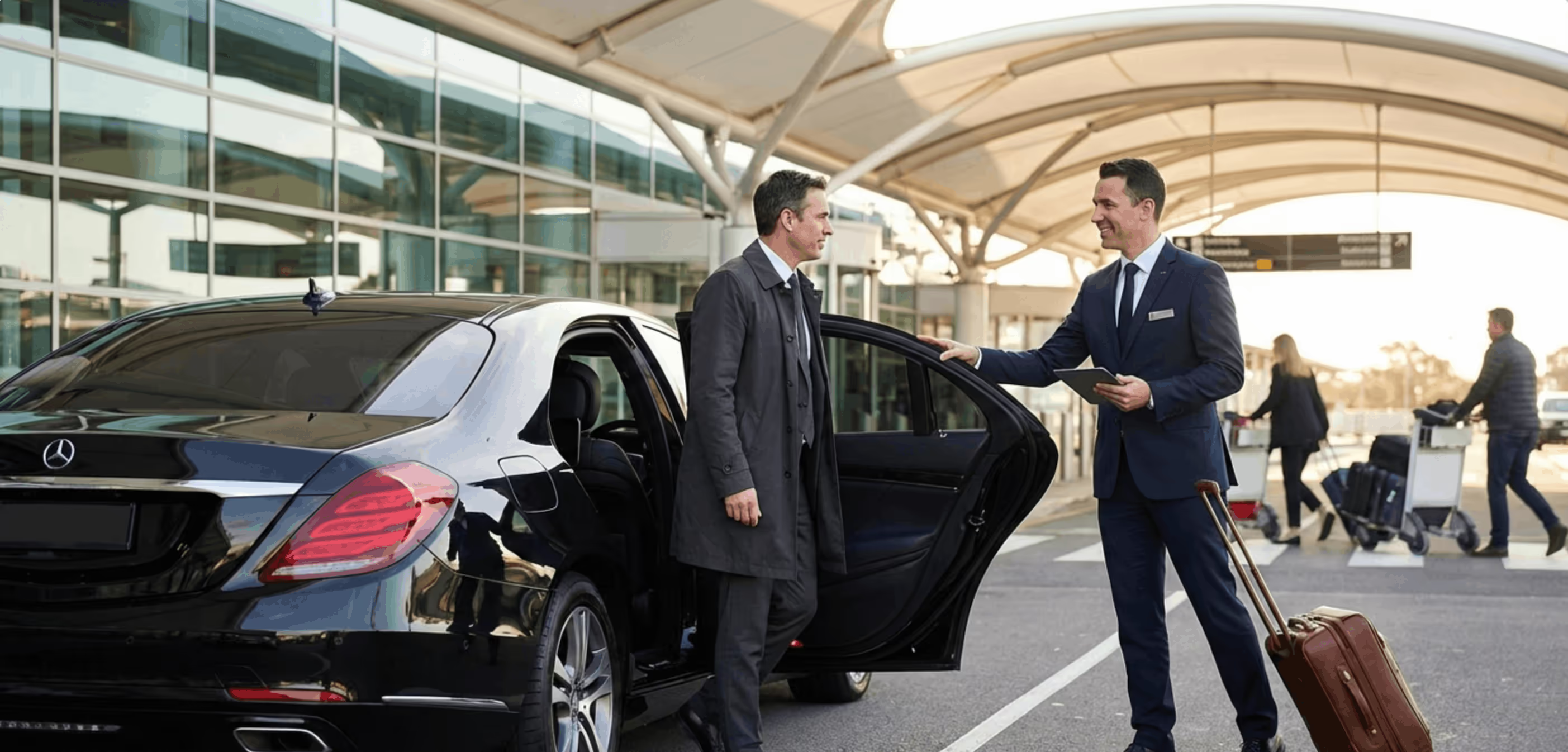
Journalists, senior brand partners, major retail buyers, and keynote guests should always receive individual vehicle pickups rather than shared shuttles. This is not about extravagance — it is about reliability and control.
Individual bookings tied to a specific pickup address and time eliminate the dependency on a shared departure schedule. If a guest is running 10 minutes late getting ready, their vehicle waits. A shuttle does not.
Managing Interstate and International Arrivals
For product launches drawing interstate guests, airport coordination is a distinct logistics stream. Key requirements:
- Flight tracking capability so drivers are notified of delays before they sit idle at the terminal
- Meet and greet at the international or domestic arrivals hall with a name board
- Vehicle holding procedures at the airport if the driver cannot access the pickup zone immediately
- Confirmed drop-off sequence if multiple guests are arriving at similar times on different flights
Cars on Demand’s RideMinder technology tracks all flights in real time and automatically adjusts driver dispatch — no manual monitoring required from your event team.
On-the-Night Coordination
Assign a dedicated transport coordinator for the event night. Their sole responsibility is to manage the vehicle fleet, communicate with drivers, and handle any changes in real time. This person should have:
- A complete manifest of all guest bookings with pickup times and vehicle assignments
- Direct communication with every driver on the ground
- Authority to add or reallocate vehicles if volumes change
Do not leave this role to the general event coordinator who is also managing catering, talent, and AV. Transport on the night needs its own person.
Influencer Transport for Product Launch Events
Of all the guest tiers at a modern product launch, influencer transport arguably carries the highest reputational stakes. Influencers are creating content in real time — before, during, and after the event. Their transport experience is content.
Why Influencer Transport Requires a Dedicated Approach
A mid-tier influencer with 200,000 engaged followers will often post their arrival experience — the car, the driver, the presentation — before they have even entered the venue. A late pickup, a budget vehicle, or a driver who does not know where the venue is will become a story. Not a good one.
Influencer transport for a product launch should be treated as part of the brand activation itself:
- Vehicles should be premium, clean, and appropriately branded or neutral depending on the launch strategy
- Drivers should be professionally presented, courteous, and discreet — not chatty about client details
- Pickup timing should be precise: influencers often have tight content schedules and back-to-back commitments
- Privacy matters — some influencers will use the travel time to review briefs, respond to messages, or change
Arrival Sequencing
If your product launch involves a physical arrival moment — a step-and-repeat, a branded entrance, a walkway — then influencer arrival sequencing matters. Work with your transport provider to stagger arrivals at 3 to 5 minute intervals so each influencer gets a clear, uncluttered arrival moment rather than arriving in a group.
This sounds like a small detail. It makes a significant difference to the quality of content captured at the door.
Post-Event Departure
Influencer transport does not end when the launch program ends. Post-event departures are logistically chaotic if unmanaged — everyone leaves at once, vehicles are not staged, and your premium guests end up waiting on a kerb.
Assign a transport steward at the venue exit. As the event winds down, have vehicles pre-staged in departure order. Influencers and VIPs should be the first out, with clear communication to their drivers 10 minutes before each guest is ready to depart.
Choosing the Right Provider for Product Launch Event Transportation
Not all chauffeur operators are equipped to manage the complexity of a product launch event. Choosing the wrong provider is one of the most common and most expensive mistakes event planners make.
What to Look For
Reliability record. Ask for documented on-time performance data. Any credible operator should be able to provide this. Cars on Demand maintains a 99.99% on-time reliability record across more than five million transfers in Australia. That number matters when your keynote starts at 7:00pm and your talent needs to be in the building by 6:45pm.
Fleet quality and consistency. Request to inspect the actual vehicles, not brochure photographs. Premium, late-model vehicles that are immaculately presented are the standard, not the exception.
Driver standards. Professional chauffeurs are not the same as rideshare drivers. Ask about driver screening, training, and presentation standards. Clients of Cars on Demand work with career professionals who understand discretion, punctuality, and client management.
Flight tracking and technology. For any event with interstate or international guests, your transport provider must have real-time flight monitoring capability. Manual tracking is not adequate at scale.
Event coordination capability. Can the provider assign a dedicated event coordinator who will be your single point of contact from planning through to the night? For product launch event transportation, you need a partner, not just a booking platform.
Fixed pricing. Surge pricing has no place in event logistics. Your transport budget should be confirmed at booking and not subject to revision based on traffic conditions or time of day. Cars on Demand operates exclusively on fixed, transparent pricing across all Australian cities.
National Coverage
If your product launch spans multiple Australian cities — a simultaneous Sydney and Melbourne activation, or a national press tour — you need a single provider with genuine national capability. Managing separate local operators in each city multiplies coordination risk significantly.
Cars on Demand operates across Sydney, Melbourne, Brisbane, Perth, Adelaide, Canberra, Gold Coast, Darwin, and the Sunshine Coast — one account, one standard, one point of contact nationally.
Sustainability
Increasingly, brands are factoring transport emissions into their event sustainability commitments. Ask potential providers about their fleet age (newer vehicles produce significantly fewer emissions), their approach to route optimisation, and whether they can provide any emissions reporting for corporate ESG purposes.
Case Studies and Best Practices
Hypothetical Case Study: National Tech Brand Launch, Sydney
A consumer technology brand launching a new product line at the ICC Sydney invited 180 guests including media, retail buyers, 30 influencers, and executive guests from interstate. The ICC Sydney presents a specific logistics challenge: its Darling Harbour location means traffic from CBD hotels is manageable, but Pyrmont Bridge Road and the Convention Centre Drive access point need to be pre-confirmed with the venue operations team before the night.
Transport was managed as follows:
- 22 individual executive sedan pickups for VIPs, media, and influencers from private addresses and CBD hotels including the Sofitel Sydney Darling Harbour and the Hyatt Regency
- 4 Mercedes-Benz V-Class shuttles running three departure waves from the official event hotel
- 2 interstate guest airport pickups coordinated via flight tracking from Sydney Airport T1
- Arrival sequencing for influencers staggered at 4-minute intervals for the branded entrance on Level 1
- 1 dedicated transport coordinator managing the manifest on the night
Result: all guests arrived within the operational window, no lateness issues reported, and three influencers specifically noted the arrival experience in their content.
Hypothetical Case Study: Melbourne CBD Product Reveal
A fashion brand hosting a product reveal dinner at a private venue in the Melbourne CBD coordinated guest transfers from two hotel pickup points — Crown Towers and the InterContinental on Collins Street — with individual pickups for 12 influencers from addresses across Toorak, South Yarra, and Fitzroy.
The key challenge for Melbourne evening events is St Kilda Road and Kings Way traffic between 6:00pm and 7:30pm. Buffer times of 35 minutes were built into every pickup, and two contingency vehicles were staged at Crown. Every guest arrived before the 7:00pm room seal time.
For events at the Melbourne Convention and Exhibition Centre, the South Wharf access roads require a specific driver briefing — vehicles dropping at the main entrance on Convention Centre Place should be pre-briefed to avoid the carpark entry lanes during high-volume arrivals.
Common Pitfalls to Avoid
Booking transport too late. Premium vehicles and professional chauffeurs are a finite resource in major cities. For events of 100 or more guests, book transport a minimum of four to six weeks in advance.
Underestimating traffic. Build in 30 to 40 percent more time than your mapping app suggests for any pickup during morning or afternoon peak in Sydney or Melbourne.
No contingency vehicles. Always have at least one additional vehicle on standby. Guest numbers shift, schedules change, and vehicles occasionally have mechanical issues. A contingency vehicle is insurance, not excess.
Inadequate driver briefing. Every driver on the event should be briefed on: the venue address and access point, the guest they are collecting, the expected pickup time, and who to call if there is an issue. A generic booking is not a driver briefing.
Mixing tiers. Do not put senior executives and junior staff in the same shuttle to save cost. Tier your transport to mirror the tier structure of the event itself.
Conclusion: Transport Is the Event Experience
The best product launches feel effortless to attendees. The product shines, the moment lands, the content is extraordinary. What guests do not see is the precision logistics operation that made that possible.
Product launch transportation done well is invisible. Guests arrive on time, in comfort, in the right vehicle, handled by a professional who knows their name and their destination. The event starts on a high note before they have walked through the door.
Cars on Demand has been managing premium event and airport transfer logistics across Australia since 1990. Our fleet, our technology, and our professional chauffeurs are available for product launches, influencer events, and corporate activations in every major Australian city.
Ready to plan your event transport? Register and book at carsondemand.link/register, or call our team on 1300 638 258 to discuss your event requirements.
.avif)
Get a quote in 8 seconds