How to Organise Diplomatic & Dignitary Transport in Australia



Save $50 on Your First Ride with Cars On Demand.

Don’t risk it, book with Cars on Demand for all your VIP transportation
If you’ve been handed the job of arranging transport for a visiting diplomat, an incoming delegation, or a government official on an official visit, you already know it isn’t like booking an ordinary airport transfer. There’s precedence to consider, timing that can’t slip, and a level of discretion that a general rideshare or taxi booking simply isn’t built for.
This guide walks through what a proper diplomatic chauffeur service covers, how to choose between a dedicated chauffeur provider and a general travel agency, and what to prepare before you book — whether you’re organising a single embassy transport run or a full foreign delegation transport program across multiple cities.
What a Diplomatic Chauffeur Service Actually Covers
“Chauffeur service” can mean very different things depending on the provider. For dignitary transport in Australia, the service should cover more than just a driver and a car. At minimum, it should include:
- Airport meet-and-greet — a driver at the gate or arrivals hall with a name board, flight tracked so delays don’t leave anyone waiting
- Discreet, professionally presented drivers briefed on protocol-level conduct, not just customer service
- A single coordinator managing the booking, not a call centre queue
- Vehicle options that match the profile of the visit — executive sedans through to people movers for larger parties
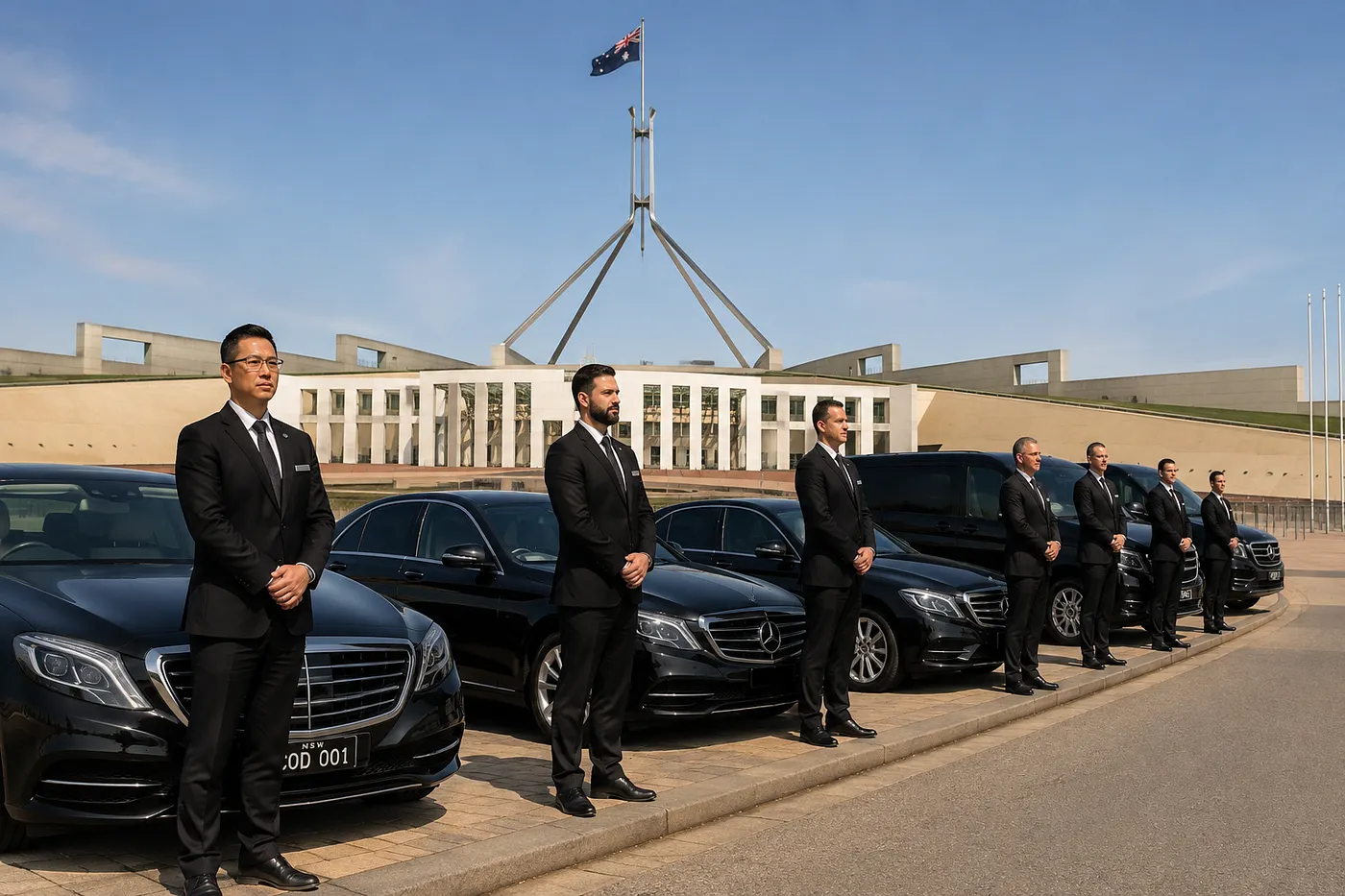
- Multi-vehicle coordination when a delegation needs lead and follow vehicles moving together
- Confidentiality as standard — passenger identities, routes and schedules aren’t shared or discussed
This is the difference between a VIP government transport provider and a general chauffeur or rideshare booking: the former is built around the assumption that the passenger’s schedule, route and identity all carry some degree of sensitivity, and plans the entire booking around that from the outset.
Chauffeur Service vs. Travel Agency: Which Should You Use?
Many departments and embassies default to booking ground transport through the same travel management company (TMC) or agency that handles flights and accommodation. It’s convenient, but it isn’t always the better option for protocol transport services, where the details that matter most — discretion, timing precision, driver briefing — often get lost in a generalist booking process.
Direct Chauffeur BookingTMC / Travel Agency BookingPoint of contactNamed coordinator, reachable directlyOften a general booking desk or portalDriver briefingBriefed specifically on protocol, discretion and timingStandard driver, no protocol briefingMulti-vehicle coordinationHandled directly with the providerCoordinated indirectly through a third partyBulk/delegation bookingsCan be submitted as one itinerary (see below)Typically booked leg by legResponse to last-minute changesDirect line to the coordinator managing your bookingChange requests routed through the agency firstCost structureDirect rate, no agency marginAgency fee or margin added to the base rate
None of this means a TMC is the wrong choice for every booking — for a straightforward, low-sensitivity transfer, it can be perfectly adequate. But for an official visit, a delegation program, or anything where a missed pickup has real consequences, booking directly with a specialist chauffeur provider gives you a shorter chain of communication and one person who owns the outcome.
What to Prepare Before You Book
Whether you’re arranging a single diplomat airport transfer or a multi-day delegation program, the booking goes more smoothly when you have the following ready:
- Full itinerary — flight numbers, arrival and departure times, and every stop in between (residence, chancery, hotel, Parliament House or equivalent government precinct).
- Passenger count and vehicle preference — how many travellers, and whether you need a single sedan, multiple vehicles, or a full motorcade with lead and follow cars.
- Protocol requirements — seating precedence, any security liaison the driver needs to be briefed on, and the level of discretion expected.
- Billing arrangement — whether this is a one-off booking or the start of an ongoing corporate account for the embassy or department.
For larger delegations: rather than booking each transfer individually, look for a provider that accepts a single Excel upload covering the full itinerary — some services can take up to 100 transfers in one submission. For a state visit or conference-scale program with dozens of movements across several days, this alone can save a travel coordinator hours of manual entry.
Coordinating Transport Across Multiple Cities
Most official visits to Australia move through Canberra, Sydney or Melbourne — sometimes all three in a single itinerary. Each city has its own considerations:
Canberra
Home to Parliament House, DFAT and the embassy precinct, so most bookings here are either routine embassy transport or coordinated support for a state visit or parliamentary function.
Sydney
Often the first port of entry for an international delegation, meaning diplomat airport transfers here set the tone for the rest of the visit.
Melbourne
A common stop for government delegations and consular staff, ranging from routine transport through to full delegation-scale events.
If your itinerary spans more than one city, it’s worth confirming upfront whether your chauffeur provider can coordinate the full route under one booking and one coordinator, rather than treating each city as a separate arrangement.
Frequently Asked Questions
Do diplomatic chauffeur drivers need any special briefing?
Yes. Beyond standard chauffeur training, drivers handling diplomatic or government bookings should be briefed on discretion, timing precision, and — where relevant — seating precedence and protocol expectations for the specific visit.
Can one provider handle a multi-vehicle delegation?
A specialist provider should be able to coordinate lead and follow vehicles, synchronised arrival times, and a single point of contact managing the whole convoy — this is one of the clearest differences between a dedicated diplomatic chauffeur service and a general transport booking.
Is a corporate account necessary for an embassy or department?
Not for a one-off booking, but for recurring official travel, a corporate account typically brings consolidated invoicing, multiple authorised bookers, and priority booking — useful when itineraries change at short notice.
How far in advance should we book?
For a confirmed itinerary, many providers can arrange transport with as little as 24 hours’ notice. Earlier notice gives more room to confirm vehicle type, meet-and-greet arrangements, and any multi-vehicle requirements.
Organising Transport for an Upcoming Visit?
Cars on Demand has provided chauffeured transport across Australia since 1990, including diplomatic and government delegation transport in Canberra, Sydney and Melbourne. If you’re arranging transport for a visiting diplomat, delegation or dignitary, our Diplomatic & Dignitary Chauffeur Services page covers the full service, or you can go straight to the city-specific pages for Canberra, Sydney and Melbourne.
Call 1300 638 258 or request a quote to get started.
.avif)
Get a quote in 8 seconds